The 3pm Crash Is Not a Willpower Problem. It Is a Blood Sugar Problem.
You know the feeling.
It hits somewhere between two-thirty and three-thirty in the afternoon, like someone pulled a plug. One minute you are functional. The next you are staring at your screen, re-reading the same sentence four times, reaching for something sweet or caffeinated just to survive the rest of the day. Your eyes feel heavy. Your motivation evaporates. Your patience gets thin.
And for years, most of us absorbed the same quiet message about that crash: you are just lazy. You need more willpower. You need to push through. Try harder. Drink more water. Go to bed earlier.
Some of those things help a little. But none of them actually fix it, because none of them address what is actually causing it.
The 3pm crash is not a character flaw. It is a blood sugar event. And once you understand what is happening inside your body when that wall hits, you will never look at your afternoon snack the same way again.

Let's Start at the Beginning of Your Day
To understand why your energy collapses at 3pm, we have to back up to the morning.
Most women start their day in one of a few ways. They skip breakfast entirely because they are not hungry or they are in a hurry. They grab something quick that is mostly carbohydrates, a piece of toast, a granola bar, a coffee with flavored creamer, maybe a banana. Or they eat what they think is a healthy breakfast but it is still light on protein and heavy on sugar, even natural sugar.
In all three of those scenarios, the same thing happens: your blood sugar spikes.
When you eat carbohydrates without pairing them with adequate protein and fat, your body digests them quickly. Glucose floods your bloodstream. Your pancreas responds by releasing insulin, whose job is to move that glucose out of your blood and into your cells for energy. When a lot of glucose floods in at once, your body releases a lot of insulin. That insulin does its job efficiently, sometimes too efficiently, and your blood sugar drops sharply below baseline.
That drop is what makes you feel tired. Foggy. Irritable. Craving sugar again.
And then the cycle repeats at lunch. A sandwich without enough protein. A big bowl of pasta with a light salad. A wrap with more tortilla than filling. Another spike. Another crash. Except this time the crash lands right at 3pm.
Your afternoon energy collapse is not a failure of discipline. It is the direct, predictable result of how your blood sugar has been riding a rollercoaster since you woke up.
What Insulin Is Actually Doing
Insulin is not the villain here. It is doing exactly what it was designed to do. The problem is that most modern eating patterns force it to work overtime in a way that disrupts everything downstream.
Here is what that process looks like in real time.
You eat a carbohydrate-heavy meal. Blood sugar rises. Insulin spikes to manage it. Blood sugar drops, sometimes below where it started. Your brain, which runs almost entirely on glucose and is extremely sensitive to blood sugar changes, registers that drop as an emergency. It sends out urgency signals in the form of cravings, fatigue, and irritability. You reach for sugar or caffeine to bring your blood sugar back up. Blood sugar spikes again. Insulin spikes again. The crash that follows is even deeper than the last one.
This is the cycle. And for women with PCOS, or women navigating the hormonal shifts of perimenopause and the years after 35, this cycle is amplified significantly.
Up to 80 percent of women with PCOS have some degree of insulin resistance. That means their cells do not respond efficiently to insulin, so their bodies produce even more of it to try to get the job done. More insulin in your system means more dramatic blood sugar swings, more intense cravings, more fatigue, more fat storage around the midsection, and a 3pm crash that feels like a complete shutdown rather than a gentle dip.
For women in their late 30s, 40s, and 50s, declining estrogen changes how the body processes insulin as well. The cells become less responsive. Blood sugar becomes harder to regulate. The same meal you ate for years starts producing a different, more disruptive response in your body. This is not your imagination and it is not aging poorly. It is a hormonal shift that requires a nutritional adjustment.
The Cortisol Connection Nobody Talks About
There is another layer to the afternoon crash that most people miss entirely, and it has to do with cortisol.
Cortisol follows a natural daily rhythm in your body. It is highest in the morning, which is part of what wakes you up and gets you moving. It gradually declines throughout the day, hitting a notable dip in the early to mid afternoon. This natural cortisol dip is part of why afternoon fatigue is a universal human experience to some degree. Many cultures have historically built rest into the afternoon for exactly this reason.
Here is where blood sugar enters the picture again. When your blood sugar crashes, your body uses cortisol as an emergency response. It releases cortisol to signal your liver to release stored glucose and bring your blood sugar back up. This means that if your blood sugar has been spiking and crashing all day, you are also triggering repeated cortisol releases all day.
By the time you hit that natural afternoon cortisol dip, your body has already been burning through its cortisol reserves for hours managing your unstable blood sugar. You are hitting the dip with less in reserve than you should have. The result is a crash that feels disproportionate to what you are doing, because it is. You are not just experiencing the normal afternoon dip. You are experiencing the normal afternoon dip on top of hours of blood sugar chaos.
Skipping meals or eating too little also triggers cortisol. When you chronically under-fuel, especially by skipping breakfast or eating a lunch that is too small, your body reads that scarcity as stress and releases cortisol to compensate. For women who are already navigating stress from work, family, poor sleep, or hormonal changes, this adds to a cortisol load that was already too high.
Why Coffee Is Not the Answer (Even Though It Feels Like It Is)
Let's talk about the afternoon coffee, because I know it is the first thing most of us reach for when the crash hits.
Caffeine works by blocking adenosine receptors in your brain. Adenosine is the chemical that builds up throughout your day and signals fatigue. When caffeine blocks those receptors, you feel more alert. The problem is that caffeine does not actually clear the adenosine. It just blocks it temporarily. When the caffeine wears off, the adenosine floods back in and you feel even more tired than you did before.
But here is the blood sugar piece: caffeine also triggers cortisol release. That cortisol release spikes your blood sugar slightly, which feels like energy. Then the blood sugar drops again. So your afternoon coffee is actually perpetuating the very cycle that caused your crash in the first place, while also pushing your cortisol higher and making it harder to fall asleep that night, which means you wake up more tired tomorrow, which means you skip breakfast or eat poorly because you are in a fog, and the whole cycle starts again.
This is not a reason to never have afternoon coffee. It is a reason to understand what it is and is not doing for you, and to pair it with food that actually stabilizes your blood sugar instead of reaching for caffeine as your only solution.
What to Do Instead
This is the part that changes things. And it is genuinely simpler than most people expect.
Anchor every meal with protein. This is the single most important habit shift you can make for blood sugar stability. Protein slows digestion. It blunts the blood sugar spike that follows a meal by slowing how quickly glucose enters your bloodstream. It keeps you full longer, which means you are less likely to graze on high-sugar foods between meals. And it supports the muscle mass that helps your cells use insulin more effectively.
Every meal should include 25 to 30 grams of protein. Eggs, chicken, salmon, ground turkey, Greek yogurt, cottage cheese, legumes. Lead with the protein on your plate. Eat it first if you can. This is not about restriction. It is about sequence and pairing.
Pair every carbohydrate with protein and fat. This is what the ARKĒN pairing principle is built around, and it applies directly to this problem. You are not cutting carbs. You are never eating them alone. An apple on its own spikes your blood sugar. An apple with almond butter does not, because the fat and protein in the almond butter slow the absorption of the sugar in the fruit. Brown rice at lunch causes a spike when eaten alone. Brown rice with salmon, avocado, and roasted vegetables does not, because the protein, fat, and fiber in the rest of the meal change how your body processes the carbohydrate.
Every time you eat a carbohydrate, ask yourself what you are pairing it with. That question alone will transform your blood sugar and your afternoon energy.
Eat breakfast within an hour of waking. Skipping breakfast keeps your cortisol elevated into the morning and sets your blood sugar on an unstable track from the moment your day starts. You do not need a large breakfast. You need a protein-anchored breakfast. Thirty to forty grams of protein within an hour of waking sets the tone for how your blood sugar behaves for the rest of the day. A spinach and egg scramble with avocado. Greek yogurt with berries and walnuts. A protein shake with whole food additions. Start with protein and your afternoon will feel different.
Eat every three to four hours. This is not permission to graze mindlessly. It is a strategic decision to prevent the blood sugar drops that happen when too much time passes between meals. When you go five, six, or seven hours without eating, your blood sugar falls, cortisol rises to compensate, and by the time you eat again your body is primed to store the calories as fat rather than burn them for energy. Eating consistently throughout the day keeps blood sugar in a stable range and keeps cortisol from being recruited as an emergency manager.
Make your afternoon snack strategic. If you know the crash is coming between 2:30 and 3:30, build a real snack into that window before the crash hits rather than reacting to it after. Carrots with hummus. Apple slices with almond butter. A hard boiled egg with a handful of walnuts. Cottage cheese with berries. Something that pairs protein and fat with a small amount of carbohydrate. This snack is not a treat. It is a blood sugar tool, and it will do more for your afternoon productivity than any amount of caffeine.
Choose slow carbohydrates over fast ones. Not all carbohydrates behave the same way in your body. Highly processed carbohydrates, white bread, crackers, chips, sugary cereals, flavored yogurts, and packaged snacks, digest quickly and cause rapid blood sugar spikes. Slow carbohydrates, the ones rich in fiber such as oats, sweet potatoes, brown rice, quinoa, lentils, and berries, digest slowly and produce a much gentler blood sugar response. When you build your meals around slow, fiber-rich carbohydrates paired with protein and fat, your blood sugar stays in a stable range and your energy follows.



The Pattern Most Women Do Not Recognize
One of the most common things I hear from women when we start talking about their eating habits is that they feel like they eat pretty well. And often they do. The problem is not the quality of individual foods in isolation. The problem is the pattern.
Breakfast that is mostly carbohydrate with very little protein. A light lunch eaten quickly or skipped entirely because the morning got away from them. A coffee and something sweet at 3pm because the crash hit and they needed to survive. A large dinner that is their first real protein-anchored meal of the day. And then a repeat the next day.
That pattern keeps blood sugar unstable from morning to night, keeps cortisol elevated all day, drives the afternoon crash, disrupts sleep, and makes weight management significantly harder regardless of how clean or healthy the individual food choices are.
The fix is not a diet. It is a reordering. Put protein at the beginning of every meal. Pair every carbohydrate. Eat consistently. Give your body the steady signals it needs to stay out of survival mode.
Your Body Is Not Broken. It Is Responding.
The 3pm crash feels personal. It feels like your body is failing you or you are failing your body. But it is neither of those things. It is a predictable biological response to a predictable set of inputs, and when you change the inputs, the response changes too.
You do not need more willpower to get through your afternoon. You need better breakfast. You need a real lunch with protein in it. You need a strategic snack timed before the crash window rather than a desperate reach for sugar after it hits.
Your body is not working against you. It is doing exactly what it was designed to do with the information you are giving it. Change the information, and your energy, your cravings, your focus, and your afternoons will change with it.
That is not discipline. That is biology. And biology, unlike willpower, does not run out.
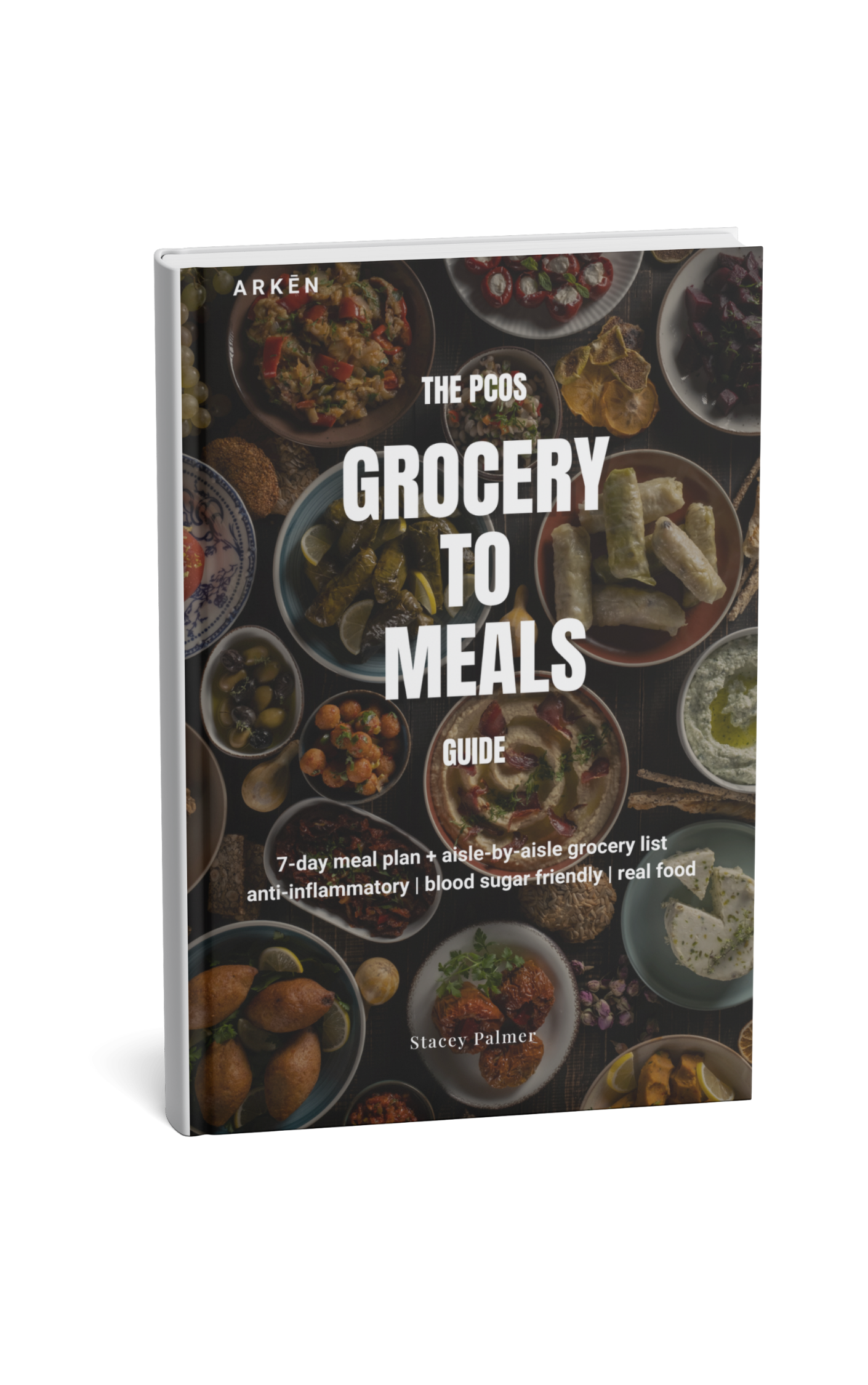
Want to see what blood sugar stable eating actually looks like day by day? The ARKĒN PCOS Grocery to Meals Guide and the 35 Plus Hormone Friendly Grocery to Meals Guide both include full meal plans built around the pairing principle. Find them at arkenfitness.com/store.